Argentine ants (Linepithema humile) throughout Southern California belong to the Very Large Colony (VLC), a massive multi-queen supercolony spanning coastal regions where individual nests cooperate rather than compete.…
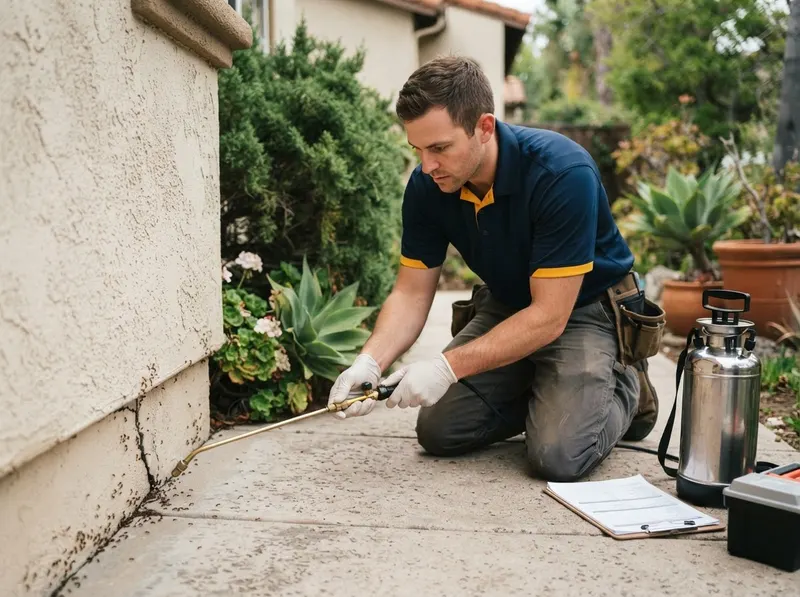
Argentine ants (Linepithema humile) throughout Southern California belong to the Very Large Colony (VLC), a massive multi-queen supercolony spanning coastal regions where individual nests cooperate rather than compete. When confronted with consumer pyrethroid sprays from hardware stores, these colonies undergo budding, a defensive dispersal mechanism where multiple reproductive queens split from the central trail and establish satellite nests deeper inside drywalls, crawlspaces, and foundation voids. In coastal enclaves like Pacific Beach, Point Loma, and Ocean Beach, marine layer moisture drives workers through structural weep holes. Inland foothill microclimates in Rancho Bernardo and Mira Mesa trigger aggressive interior foraging during dry Santa Ana wind events, sending thousands of foraging workers across kitchen countertops in search of municipal plumbing condensations.
Decision-fit for genuine colony eradication depends on the structural profile. Exterior non-repellent perimeter applications paired with carbohydrate and protein matrix baits fit residential structures experiencing seasonal trailing along foundation lines; the trade-off is that non-repellent compounds require 5 to 14 days of active foraging to circulate across the subterranean caste system, ruling out instantaneous contact mortality. Properties adjacent to heavy canyon brush or riparian greenbelts in North Park, Hillcrest, and Mission Valley require broader perimeter zones up to 10 feet out, treating soil contact zones near utility penetrations and irrigation manifolds to halt structural ingress.
Technical intervention follows an exact sequential process. 1. Structural trailing lines are surveyed along concrete expansion joints, stucco weep screeds, and garden hose bibs to identify primary sub-soil gallery entrances. 2. Non-repellent liquid barriers are applied precisely along stem walls and perimeter soils using low-pressure distribution rigs. 3. Slow-acting biochemical matrices are placed adjacent to active outdoor supply lines, allowing sterile worker ants to ingest the bait and transport the compound back into subterranean nesting galleries. 4. Queens and brood larvae ingest the compound via trophallaxis (communal food-sharing), systematically shutting down reproductive continuity across all satellite chambers without interior chemical broadcasting.
Every job gets a firm, written price after a free on-site visit.
Tell us about your argentine ant colony eradication job in San Diego and we'll send a clear, written quote, usually the same day.
 PestPilot Pest Control